
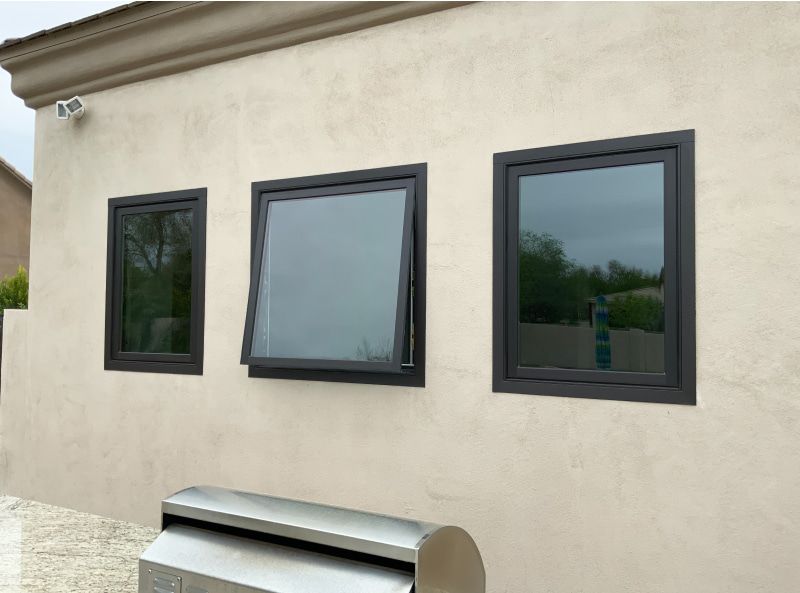
High-Contrast Elegance: The Definitive 2026 Guide to Black Windows on White Houses
There is a moment every homeowner recognizes.
You scroll past a photo of a crisp white farmhouse with deep black window frames and something clicks. The contrast is clean. The architecture feels resolved. The house looks intentional in a way that no neutral-on-neutral palette ever achieves.
That moment is the beginning of a serious renovation decision, and it deserves a serious answer.
Because here is what the design blogs will not tell you: choosing black windows on a white house is not just an aesthetic decision. It is a materials science decision. The color you put on an exterior window frame determines how much solar radiation that frame absorbs, how hot its surface gets on a July afternoon, and whether the frame maintains its dimensional stability across twenty years of thermal cycling, or fails within eight.
This guide was written to give you the complete picture. The physics, the performance data, the honest cost conversation, and the engineering specifics that separate a permanent upgrade from an expensive mistake.
Whether your home sits in Phoenix under 299 days of annual sun, in Dallas facing hail season and 100-degree summers, or on the coast of Rhode Island cycling through 60 freeze-thaw events every winter, the principles here apply directly to your project.
Key Takeaways: High-Contrast Window Design & Performance
- A Materials Science Decision: Choosing black exterior frames is a structural commitment, not just an aesthetic trend. On hot summer days, dark surfaces absorb massive solar radiation, pushing frame temperatures up to 155°F–175°F.
- The Dark Color Trap of Vinyl: Standard dark-painted or foil-wrapped vinyl (uPVC) components frequently warp, bow, and experience seal degradation because their surface temperatures routinely meet or exceed their material softening points.
- The Fibrex® Material Solution: Custom-manufactured replacement windows from Renewal by Andersen are engineered from exclusive Fibrex® material—a revolutionary composite that is twice as strong as vinyl, blocks thermal transfer nearly 700 times better than aluminum, and possesses a low coefficient of thermal expansion to completely resist warping in extreme climates.
- Elimination of Structural Failure Points: Unlike standard dark vinyl windows that fail at the seams, sashes built with Fibrex® material are constructed without separate glazing beads, permanently locking the glass within the frame and providing superior forced-entry defense.
- Absolute Sizing Precision: Following contract approval, an Installation Manager conducts a meticulous Technical Measure to a precise 1/16-inch tolerance. This guarantees a perfect fit within the existing structural pocket and can preserves original home trim.
- Advanced Interior UV Protection: High-contrast white home interiors are highly vulnerable to sun damage. Specifying High-Performance Low-E4® SmartSun™ glass explicitly blocks 95% of harmful UV rays, preventing the fading, bleaching, and yellowing of luxury furnishings, walls, and flooring.
- Manufacturer-Direct Installation Authority: High-visibility architectural updates should never be left to generalized hired help or general contractors. Certified Master Installers execute specialized, all-temperature installation protocols to manage thermal dynamics and ensure absolute structural integrity.
- The Ultimate Valuation Safety Net: Every window replacement project is protected by a fully and automatically transferable, non-prorated limited warranty. Because it links directly to the property address rather than the individual homeowner, it transfers seamlessly during a sale to serve as a verified home equity asset.
The National Association of Realtors consistently ranks window replacement among the top ten home improvement projects for cost recoupment.
In thermally aggressive markets like Phoenix, Las Vegas, and West Texas, painted dark vinyl windows follow a predictable failure timeline. Glazing bead separation begins around year five to eight. Frame warping causes operational failure by year eight to ten. Full replacement, plus interior damage remediation for any water infiltration, typically arrives between years twelve and fifteen.
The "savings" from the cheaper product are consumed entirely, and then some.
The long-term net present value of the premium composite product is decisively positive. This is the "Buy It Once, Buy It Right" philosophy expressed in actual numbers: a capital allocation decision, not a style preference.
Pro Tip: When evaluating window quotes, ask specifically whether the dark finish is surface-applied (painted or foil-wrapped) or integral to the material matrix. That single question separates a 5-year finish from a 30-year finish.
This is the core argument that most window guides skip entirely.
Dark colors absorb solar radiation across the full visible and near-infrared spectrum. A black surface has an absorptivity of 0.95 to 0.97. A white surface absorbs only 0.30 to 0.40. On a 95-degree afternoon with direct sun exposure, a black vinyl frame surface reaches 155 to 175 degrees Fahrenheit. A white frame surface on the same house reaches only 100 to 115 degrees Fahrenheit.
That 40 to 60 degree differential is the entire structural problem.
Standard vinyl (uPVC) has a Vicat softening point of approximately 165 degrees Fahrenheit. That is the temperature at which the material begins to lose dimensional stability. In Phoenix, Las Vegas, and West Texas, dark-colored vinyl frames routinely reach or exceed this threshold on peak summer days.
This is not a cosmetic concern. It is a materials science failure point.
Vinyl also has a coefficient of thermal expansion (CTE) of approximately 50 to 100 x 10 to the negative sixth per degree Celsius. Over a six-foot window frame span experiencing a 100-degree Fahrenheit temperature swing, that translates to 3/8 to 3/4 inch of linear expansion. That is why glazing beads separate. That is why air seals fail. That is why water infiltration begins.
The frame has physically moved away from its seal.
Pro Tip: Ask any window contractor for the CTE specification of their frame material. If they cannot answer, that tells you everything you need to know about the depth of their engineering knowledge.
The physics above are not abstract. They play out differently in each market, and the specifics matter.
In Dallas and Fort Worth, the combination of 234 sunny days per year and four to six significant hail events annually creates a compounded threat. Frames already stressed by thermal cycling develop micro-cracks that dramatically increase susceptibility to hail impact fracture. A structurally compromised frame does not just look bad after a hail event. It fails.
In Phoenix, the numbers are unambiguous. The city averages 299 sunny days per year with peak solar irradiance of 6.5 to 7.0 kWh per square meter per day. Dark vinyl frames experience a delta-T (the difference between frame surface temperature and ambient air temperature) of 50 to 70 degrees Fahrenheit on peak summer days. Painted dark vinyl in Phoenix has a documented failure pattern of chalking and delamination within five to eight years. This is not a hypothetical. It is a predictable outcome of physics.
In Colorado, the threat profile shifts. At 6,000 feet of elevation, UV radiation intensity is 25 to 50 percent higher than at sea level. Standard UV protection ratings on painted vinyl finishes are calibrated for sea-level exposure. At altitude, dark pigments degrade measurably faster. Boulder averages 300 sunny days per year, more than Miami, combined with dramatic diurnal temperature swings of 30 to 40 degrees Fahrenheit. Colorado Springs adds 57 inches of annual snowfall and freeze-thaw cycles that stress frames already weakened by UV degradation.
The market is not a footnote. It is a design specification.
Pro Tip: Before selecting any dark-frame window product, map your specific climate zone against the material's published CTE and UV stability data. In Phoenix, Las Vegas, or West Texas, anything less than an integral-color composite is a calculated gamble.
Now that you understand the physics, you can evaluate materials with precision.
The window industry has two fundamental approaches to dark frames. Surface treatment (painting or foil-wrapping a vinyl extrusion in a dark color) and integral coloration (a composite material where the dark pigment is part of the material matrix itself). These are not variations on the same solution. They are fundamentally different products with fundamentally different lifespans.
The Structural Failure Cascade of Dark Vinyl: A Step-by-Step Breakdown
Here is what actually happens to a painted dark vinyl window over time.
Years zero to two: Performance is adequate. Minor thermal expansion occurs but stays within tolerance. The dark finish looks sharp.
Years three to five: Cumulative thermal cycling begins stressing the paint or foil bond. Micro-cracking appears at corners and edges, the highest stress concentration points in any extruded frame. UV degradation begins chalking the dark pigment. The aesthetic starts to degrade.
Years five to eight: In high-stress markets like Phoenix, Las Vegas, and West Texas, glazing bead separation begins. Air infiltration increases. A window that tested at a U-factor of 0.30 may now perform at 0.35 to 0.40 due to seal degradation. Energy bills climb. The efficiency you paid for is gone.
Years eight to twelve: Frame warping causes operational failure in severe cases. Sashes that once opened smoothly now bind or will not close fully. Water infiltration begins. Interior damage follows: mold, rot in wood framing members, drywall damage.
Years twelve to fifteen: Full replacement is required. The cost savings from the cheaper product have been consumed entirely by replacement cost plus interior damage remediation.
This is not a worst-case scenario. It is the predictable lifecycle of surface-treated dark vinyl in thermally aggressive climates.
Pro Tip: When a contractor quotes you a painted vinyl window in a dark finish at a significant discount, ask them for the warranty terms specifically on the finish. The answer will be instructive.
Fibrex® material is not a vinyl product. It is a proprietary composite of approximately 40 percent reclaimed wood fiber and 60 percent thermoplastic polymer.
The wood fiber component is the key.
Wood has a very low CTE compared to pure polymer. The fiber matrix constrains the thermal expansion of the polymer phase, producing a composite CTE that is significantly lower than pure vinyl and behaves more like wood (CTE of approximately 3 to 5 x 10 to the negative sixth per degree Celsius). This is why Fibrex® material can be manufactured to a 1/16-inch tolerance and hold that tolerance across twenty-plus years of thermal cycling.
Fibrex® material is also twice as strong as vinyl in tensile and flexural strength. That means it resists the bending and warping forces that cause vinyl frames to bow under thermal load.
And then there is the glazing bead question.
Renewal by Andersen designs window sashes completely without separate glazing beads. Glazing beads are the first component to separate under thermal stress in conventional vinyl windows. Their absence in Fibrex® material construction eliminates a primary failure point entirely. The glass is permanently sealed within the sash without a removable bead that can be pushed out by thermal expansion.
The result is a window that insulates 700 times better than aluminum, maintains its dark finish across its full service life because the pigmentation is integral to the material matrix, and holds its dimensional precision because its CTE is fundamentally lower than vinyl.
Pro Tip: Ask for the published CTE specification for any composite window material you are evaluating. If the number is close to vinyl (50 to 100 x 10 to the negative sixth per degree Celsius), the material will behave like vinyl under thermal stress regardless of what it is called.
The visual language of black windows on a white house is defined almost entirely by grille selection.
Three paths are available, and each serves a different architectural vocabulary.
Contoured and designer Grilles-Between-the-Glass (GBG) are permanently sealed within the insulated glass unit. They cannot trap dust. They cannot be damaged by cleaning. They maintain their visual appearance indefinitely. For the high-contrast look, GBG patterns in a dark frame create a grid-within-a-grid visual effect that references historic divided-light windows while delivering modern thermal performance. This is the right choice for traditional, Colonial, and Craftsman architecture.
Removable interior wood grilles in premium hardwood species, including maple, oak, and pine with a range of stain options, add interior warmth to what can otherwise be a stark black-frame aesthetic. This option is particularly relevant for Northeast markets including Rhode Island, Connecticut, and Cape Cod, where Colonial and Federal architectural styles demand interior wood detail as a period-correct design element.
No-grille configurations deliver the clean, uninterrupted sightline that defines modern and contemporary architecture. This is the dominant choice in Boulder, Austin, and the Philadelphia suburbs, where the narrow Fibrex® material frame profile maximizes glass surface area and the unbroken black rectangle against white cladding is the entire design statement.
Pro Tip: Match your grille selection to your architectural style before you finalize your window configuration. GBG grilles are permanent. Interior wood grilles are removable. No-grille is irreversible in the opposite direction. Make this decision with intention.
Deep Dive: The Technical Measure Process
After a comprehensive project quote is finalized and the contract is approved, an Installation Manager takes over the project to execute a rigorous Technical Measure.
Rather than using standard off-the-shelf sizing or relying on rough estimates, the process measures every opening to a precise 1/16-inch framework.
This precision is only meaningful because of the material science behind it. Because Fibrex® material has a CTE that behaves more like wood than vinyl, the window manufactured to that 1/16-inch specification will maintain that precision across its full operational temperature range. A vinyl window cannot be manufactured to the same tolerance because the material will thermally expand beyond it.
The Technical Measure guarantees that your custom-manufactured black windows fit perfectly into the existing structural pocket, maintaining the absolute integrity of your home's original interior and exterior trim.
This is the engineering loop that connects material science to installation quality. Precision measurement is only as good as the material that holds it.
Pro Tip: Never accept a window installation that skips an in-person measurement process. Off-the-shelf sizing introduces gaps that compromise both thermal performance and structural integrity from day one.
Performance is not a single number. It is a system.
The best black window installation in 2026 integrates frame material, glass specification, natural light optimization, and financial protection into a single coherent decision. Here is how each component of that system works.
The Glass Surface Area Advantage: Narrow Frames and Natural Light
Fibrex® material frames are thinner than vinyl frames of equivalent structural strength.
This is a direct consequence of the material's superior tensile and flexural strength. A thinner section of Fibrex® material provides the same structural performance as a thicker section of vinyl. The practical result for the homeowner: more glass area per rough opening.
In cold-climate markets like New Hampshire and Portland, Maine, that additional glass area also means more passive solar heat gain during winter months, which directly reduces heating load. In all markets, the psychological and physiological benefits of natural light are well-documented: improved circadian rhythm regulation, reduced artificial lighting costs, and measurably higher perceived interior quality.
The narrow frame is not a cosmetic feature. It is a performance specification.
Pro Tip: When comparing window quotes, ask for the actual glass surface area (also called daylight opening) for each product in your specific rough opening size. The difference between a narrow composite frame and a wide vinyl frame is visible in both the number and the room.
High-Performance Low-E4® SmartSun™ Glass: The UV Blocking Math for White Interiors
Standard Low-E glass (Low-E²) blocks approximately 75 to 84 percent of UV radiation. High-Performance Low-E4® SmartSun™ glass blocks 95 percent.
That 10 to 20 percentage point differential is not marginal. Over ten years of direct sun exposure in a sun-belt home, it is the difference between a preserved interior and a measurably faded one.
Here is why this matters specifically for the black-windows-on-white-house aesthetic.
White interiors are the natural complement to high-contrast black frames. White-painted walls, white-upholstered furniture, and light hardwood floors are the typical interior palette that accompanies this architectural style. These surfaces show UV damage more visibly than darker palettes. Yellowing on white walls. Bleaching on light hardwood. Color shift in upholstery and textiles.
The 95 percent UV blocking figure from High-Performance Low-E4® SmartSun™ glass is also 70 percent more energy-efficient in summer and 45 percent more energy-efficient in winter compared to common dual-pane glass. In Phoenix, Austin, and Las Vegas, where homes face intense southwest afternoon sun, this performance level is not a luxury specification. It is a baseline requirement for protecting both the interior design investment and the structural integrity of the window system itself.
The glass is doing two jobs simultaneously: managing solar heat gain to reduce cooling load, and blocking UV radiation to protect the interior. High-Performance Low-E4® SmartSun™ glass executes both with measurably superior performance.
If you are ready to see exactly which glass and frame configuration is right for your specific home and climate, take the project quiz to receive a customized recommendation.
Pro Tip: In sun-belt markets, specify the SHGC (Solar Heat Gain Coefficient) for any glass package you are considering. A lower SHGC means less solar heat entering the home. High-Performance Low-E4® SmartSun™ glass is optimized specifically for high-sun-exposure climates.
The financial protection framework for a window replacement project in 2026 has two components: price stability and rebate eligibility.
The 1-year price guarantee locks the quoted price from contract approval through manufacturing and installation. Window manufacturing involves aluminum, glass, and polymer components whose prices are subject to commodity market fluctuations. In a post-pandemic construction materials environment where prices have been volatile, a locked price guarantee eliminates the risk of cost escalation between the day you sign and the day your windows are installed.
On the incentive side, the landscape is regional and changes annually. Rather than citing figures that may be outdated by the time you read this, here is the accurate framework.
In Rhode Island, National Grid and Pascoag Utility District have offered rebates for qualifying window replacements. In Connecticut, Eversource and United Illuminating operate Home Energy Solutions programs that include fenestration upgrades. In Colorado, Xcel Energy has rebate programs for qualifying windows in the Boulder and Colorado Springs service areas. In Texas, Oncor (serving Dallas and Fort Worth) and CPS Energy (serving San Antonio) maintain energy efficiency rebate programs. In Oklahoma, OG&E and PSO have offered efficiency incentive programs for qualifying upgrades.
Every one of these programs changes its terms, eligibility thresholds, and funding availability on an annual basis. Verify current eligibility directly with your utility provider before finalizing your project budget.
Pro Tip: Call your utility provider before your final project consultation. Ask specifically whether your planned window upgrade qualifies for any current rebate or incentive program. A Project Consultant can help you document the performance specifications needed to support a rebate application.
The window is only as good as the installation.
This is not a platitude. It is a structural reality. A precision-manufactured Fibrex® material window installed with improper flashing, incorrect fastening, or inadequate thermal break technique will underperform a lesser product installed correctly. The installation is half the system.
The Manufacturer-Direct Training Advantage: What General Contractors Cannot Replicate
Renewal by Andersen's Certified Master Installers are trained specifically in the techniques that determine long-term performance.
Thermal break installation ensures that the window frame is installed with appropriate thermal break materials at the rough opening interface, preventing thermal bridging that would otherwise negate the frame's insulation performance. A general contractor installing a premium window without proper thermal break technique is leaving measurable energy performance on the table.
All-temperature installation protocols address a critical seasonal challenge. Many sealants have minimum application temperatures of 40 degrees Fahrenheit. Improper cold-weather installation, common in New Hampshire, Maine, and Colorado during shoulder seasons, is a documented cause of early seal failure. Certified Master Installers are trained in cold-weather application techniques that maintain sealant bond integrity regardless of ambient temperature.
Fibrex® material-specific fastening patterns matter because the composite material has specific requirements that differ from vinyl. Incorrect fastening can introduce stress concentrations that cause micro-cracking over time.
Flashing and water management at the head, sill, and jambs is the single most important determinant of long-term water infiltration performance. It is also the area where generalist contractors most frequently underperform. Head flashing in particular is a critical detail: improper head flashing is the primary entry point for the water infiltration that causes interior damage.
This is the decision most homeowners do not know they need to make until it is too late to make it well.
Insert (pocket) replacement is appropriate when the existing frame and rough opening are structurally sound, the exterior trim is in good condition and worth preserving, and the homeowner wants to minimize disruption. Insert replacement is faster (typically one to two hours per window) and preserves existing interior and exterior trim profiles. The tradeoff: glass surface area is reduced compared to full-frame, because the new frame sits inside the old frame.
Full-frame replacement is required when there is evidence of rot, water damage, or structural compromise in the existing frame or rough opening. It is also the right choice when the homeowner wants to maximize glass area, change window size or configuration, or when existing trim is already damaged or non-original. Full-frame replacement involves complete deconstruction of the rough opening, including exterior trim, interior casing, and potentially sill flashing. Existing trim preservation cannot be guaranteed in a full-frame replacement.
For homeowners with historic moldings or custom exterior trim on a white house, this distinction is critical. An insert replacement preserves that trim. A full-frame replacement may not.
The 6 to 8 week manufacturing lead time for custom Fibrex® material windows is a direct consequence of made-to-order manufacturing. Every window is built to the exact specifications captured in the Technical Measure. This is not a delay. It is the quality indicator that separates custom manufacturing from off-the-shelf sizing.
Pro Tip: If your existing window frames show any soft spots, discoloration, or visible moisture damage, request a full-frame replacement assessment before defaulting to an insert. The cost of discovering rot after an insert installation is significantly higher than addressing it before.
Installation complexity is not uniform across markets.
In the Northeast, covering Maine, New Hampshire, Rhode Island, and Connecticut, cold-weather installation protocols are non-negotiable. Winter installations require heated work areas for sealant application, pre-warming of frame components to prevent thermal shock, and accelerated flashing installation to minimize exposure of the rough opening to precipitation. Portland, Maine averages 61 inches of snow and 156 days below freezing annually. Installation quality during these conditions separates a twenty-year window from a five-year problem.
In Phoenix, Las Vegas, and West Texas, heat management during installation is the primary concern. Sealants and adhesives can cure too rapidly in extreme heat, reducing bond strength. Certified Master Installers in these markets work in early morning hours and use shade structures to maintain appropriate application temperatures. A window installed at 2 PM in August in Phoenix under direct sun is not the same installation as one executed at 7 AM with proper shading.
In Dallas, Oklahoma City, and the broader severe weather zone, installation scheduling must account for weather windows. A partially installed opening during a hail event is a significant liability. Proper staging and rapid completion protocols are essential in markets that average 60-plus severe weather days per year.
Pro Tip: When scheduling your installation, ask your Installation Manager about the specific seasonal protocols they use in your market. The answer reveals the depth of their regional expertise.
Deep Dive: Understanding the Automatic Transferable Warranty
Every custom high-contrast window replacement project through Renewal by Andersen is backed by a fully and automatically transferable, non-prorated limited warranty: 20 years on glass and Fibrex® material, 10 years on hardware.
The structure of this warranty is its most important feature.
Traditional warranty registration systems require the original owner to notify the manufacturer of a sale and the new owner to re-register. This process fails in the majority of residential real estate transactions. The paperwork gets lost. The deadline passes. The coverage lapses precisely when it is most needed.
Renewal by Andersen's® warranty is linked directly to the property address, not to the individual purchaser. There is no paperwork. There is no registration requirement. There is no deadline. When the home is sold, the warranty transfers automatically to the new owner.
In real estate transaction terms, this is a quantifiable asset. In a competitive offer situation, a verified, fully transferable window warranty is a documented item that a buyer's inspector will note positively. It reduces the probability of a warranty-related negotiation credit request at closing. It is a financial instrument, not just a customer service feature.
Pro Tip: Keep your original installation documentation in your home's records file. While the warranty transfers automatically by address, having the original project documentation accelerates any future service requests and strengthens the asset value at resale.
You now have the complete picture.
You understand why dark frames are a thermal loading decision, not just an aesthetic one. You know the difference between a surface-treated vinyl finish that will chalk and delaminate within five to eight years in a sun-belt market and an integral-color Fibrex® material composite that holds its precision and its appearance across its life. You understand the glass performance math, the installation complexity variables, and the financial protection framework that makes this a sound capital allocation decision.
The next step is a project quote built specifically for your home, your climate, and your architectural vision.
Start here to take the project assessment and connect with a Design Consultant who will build your comprehensive project quote.
Black windows on a white house done right is a permanent upgrade. Do it once. Do it right.
The decision to install black windows on a white house is, at its core, a twenty-year materials commitment. The homes that execute this look flawlessly in 2036 and 2046 will be the ones where the frame material was chosen for its engineering properties, not just its finish color. Fibrex® material's lower coefficient of thermal expansion, integral pigmentation, and superior structural strength are not marketing claims. They are the physical reasons why a precision-measured, custom-manufactured window holds its appearance, its performance, and its warranty value across decades of thermal cycling, UV exposure, and seasonal weather stress. Invest in the material that matches the permanence of the statement you are making.
¹ Values are based on comparison of Renewal by Andersen® glass performance (U-Factor and SHGC) to that of common dual-pane glass. ***See Renewal by Andersen® Products and Installation Transferable Limited Warranty for details.