As homeowners navigate the evolving energy standards of 2026, the front door remains one of the most critical—and frequently overlooked—points of thermal vulnerability in residential building envelopes. When replacing existing entry systems, many homeowners initially seek out QA common concern we hear during in-home consultations is the presence of a persistent chill near the front entryway, even when the door appears fully closed and locked. This phenomenon is often mistaken for a simple draft, but it is frequently the result of a physical process known as thermal bridging. A thermal bridge occurs when highly conductive materials—such as standard aluminum or steel sills—create a direct pathway for outdoor temperatures to bypass your home's insulation and conduct straight into your interior flooring.
In heating-dominated climates like New Hampshire, Portland, Maine, and Cape Cod, a standard metal threshold acts as a heat sink, drawing interior warmth out of the home and allowing freezing outdoor temperatures to chill the interior sill. This can lead to unwanted condensation, frost lines, and localized moisture accumulation that ruins interior flooring. Conversely, in the intense summer heat of Phoenix, Tucson, and Las Vegas, uninsulated conductive sills transfer extreme exterior heat directly into your air-conditioned living space, forcing your HVAC system to run continuously.
The permanent solution requires engineered thermal breaks. A high-performance door threshold integrates specialized, low-conductivity composite materials that mechanically interrupt this heat transfer pathway. By separating the exterior-facing components of the sill from the interior-facing components with an impenetrable insulating barrier, the conductive chain is completely broken. This ensures that the interior surface of your threshold remains close to your ambient room temperature, dramatically improving floor-level comfort and preventing costly energy loss.
Equally important to the thermal break is the mechanical design of the sill itself. Every home experiences structural settling over its lifespan. Foundations shift slightly due to soil consolidation, particularly in regions with severe seasonal moisture variations and expansive clay soils like Dallas, Fort Worth, Austin, and San Antonio. When a home settles, a standard, fixed-height door sill cannot adapt, inevitably creating a visible gap between the bottom of the door slab and the threshold.
Renewal by Andersen®’s addresses this structural reality by utilizing adjustable sills in our replacement entry systems. An adjustable threshold allows for precise, micro-targeted height modifications over time. After the initial installation, and as your home naturally settles through the changing seasons, the sill can be finely adjusted using integrated mechanical tension screws to maintain a perfect, permanent seal against the bottom weatherstripping. This engineered adaptability ensures that your entryway remains completely airtight and structurally sound for decades, providing complete peace of mind.
The Anatomy of a High-Performance Door Threshold
A common concern we hear during in-home consultations is the presence of a persistent chill near the front entryway, even when the door appears fully closed and locked. This phenomenon is often mistaken for a simple draft, but it is frequently the result of a physical process known as thermal bridging. A thermal bridge occurs when highly conductive materials—such as standard aluminum or steel sills—create a direct pathway for outdoor temperatures to bypass your home's insulation and conduct straight into your interior flooring.
Weatherstripping Science: Compression vs. Sliding Seals
Homeowners frequently express frustration over weatherstripping that peels, cracks, or fails after just a few seasons. It is completely natural to feel discouraged when a recently applied retail seal begins to let cold air in again. This recurring issue stems from the faulty material science of standard retail solutions.
Most commodity door sweeps rely on sliding plastic or vinyl seals. These materials are designed to drag heavily across the threshold every time the door opens and closes, creating constant mechanical friction. In climates with extreme temperature cycling—such as the rapid high-altitude shifts seen in Denver, Boulder, and Colorado Springs—these plastics quickly lose their elasticity. Ultraviolet (UV) radiation breaks down the polymer chains, while freezing and thawing cause the material to become brittle. Within a couple of years, sliding plastic sweeps suffer from permanent deformation, leaving visible gaps that invite drafts.
In contrast, our engineered replacement door systems utilize advanced, high-performance compression weatherstripping designed for maximum sealing force. Our premium Ensemble™ Entry Doors utilize a highly responsive, supple foam core seal encased in an ultra-durable, UV-resistant exterior matrix that compresses tightly without dragging or tearing. For specific regional applications and customized market selections, our alternative door lines implement specialized CornerShield™ technology—a resilient composite weatherstripping system designed to withstand extreme physical friction and block air gaps at the critical corner junctions of the frame entryway. Instead of sliding and wearing down, these systems create a continuous, mechanical barrier that retains its structural memory long after standard retail sweeps have permanently deformed.
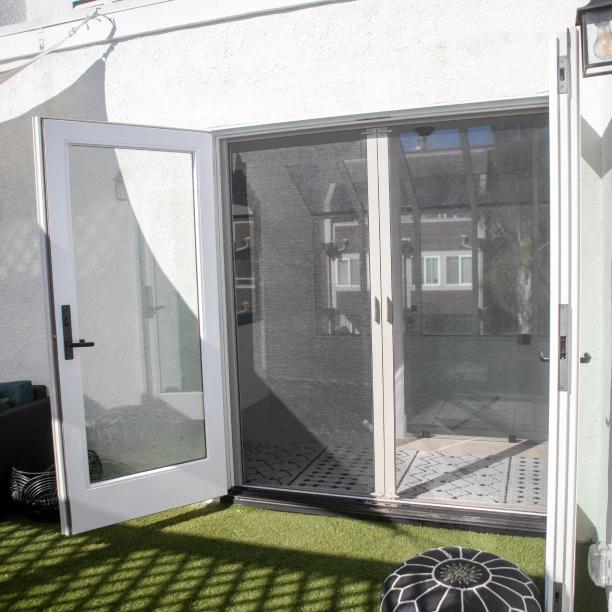
This commitment to precision sealing extends to our patio door configurations as well. For homeowners replacing their patio access points, our Frenchwood® Hinged patio doors feature an advanced inter-locking weatherstripping system. Historically, multi-panel hinged doors suffered from a "middle-gap" draft where the panels met in the center. Our inter-locking technology eliminates this vulnerability completely. The weatherstripping on the door panel is engineered to physically interlock with a mating strip on the jamb. When the door closes, these strips engage sequentially, creating an airtight, uniform compression seal that prevents air from bypassing the center of the unit.
ENERGY STAR® 2026 Benchmarks for Entry Systems
As building codes and energy efficiency standards evolve into 2026, the metrics used to measure door performance have become increasingly stringent. For homeowners, understanding these benchmarks provides absolute clarity on the value of their investment. The two most critical measurements are the U-Factor and the air infiltration rating.
The U-Factor measures the rate of non-solar heat flow through a door assembly; a lower number indicates superior insulation. Air infiltration measures how many cubic feet of air pass through the door system under specific atmospheric pressure conditions. A replacement door can only achieve high-level ENERGY STAR® benchmarks if both the frame insulation and the weatherstripping are optimized in tandem. Our front doors feature durable composite skins and high-density foam-filled slabs that provide exceptional thermal resistance, working in perfect harmony with our compression seals to lower both U-Factor and air infiltration rates well below standard building mandates.
Furthermore, the glass integrated into your entry door—known as door lites—plays a massive role in overall performance. Our premium entry lines—including Ensemble™ Entry Doors and Frenchwood® patio doors—exclusively utilize High-Performance Low-E4® SmartSun™ glass filled with custom Argon gas blends for maximum insulation, while our strategic regional door lines feature comparably optimized, high-efficiency energy-certified glass packages engineered for severe localized climate demands. This advanced glass technology is up to 70% more energy-efficient in summer and 45% more energy-efficient in winter compared to ordinary dual-pane glass.¹
Beyond temperature control, this glass technology serves as a protective shield for your home's interior furnishings. In sun-drenched markets like Oklahoma City, Phoenix, and Las Vegas, UV radiation entering through front door glass can cause severe fading to hardwood floors, antique rugs, and upholstery. High-Performance Low-E4® SmartSun™ glass blocks 95% of harmful UV rays, preserving your interior investments while allowing beautiful, natural light to flood your entryway. Whether you choose permanent Full Divided Light (FDL) configurations to replicate the vintage charm of an older home or clean, open profiles, the thermal integrity of the glass remains completely uncompromised.
Standard Industry Practices vs. The Renewal by Andersen®’s Advantage
- Threshold Mechanics
- Standard Industry Practices: Reliance on fixed-height metal sills that conduct heat and cannot adapt to natural structural home settling, resulting in open gaps.
- The Renewal by Andersen®’s Advantage: Engineered thermal break thresholds and adjustable sills that maintain a permanent, airtight seal regardless of structural movement.
- Weatherstripping Materials
- Standard Industry Practices: Use of commodity plastic or vinyl sweeps that crack, peel, drag, and fail within 18 to 36 months of friction and UV exposure.
- The Renewal by Andersen®’s Advantage: Supple foam seals and CornerShield™ composite configurations designed for decades of shape retention and UV resistance.
- Installation & Support
- Standard Industry Practices: Installation performed by general contractors or temporary hired help using generic, off-the-shelf materials and volatile line-item pricing models.
- The Renewal by Andersen®’s Advantage: Executed exclusively by our Certified Master Installers backed by a comprehensive project quote that serves as a 1-year guarantee against price inflation.
If you are tired of temporary fixes and ready to permanently upgrade your home's thermal envelope, we invite you to take our quick quiz to explore your options and see how a custom-engineered solution can transform your entryway.
Eliminate the Chill: Book Your Home Energy Envelope Review
The transition from a drafty, underperforming entryway to an airtight thermal envelope begins with a professional diagnosis. We encourage homeowners to stop relying on temporary door snakes, adhesive tapes, and seasonal patches. These items only mask the symptoms of energy loss while allowing thermal bridging and structural degradation to continue unseen.
Our Philosophy on a Professional, In-Home Consultation is centered on education, transparency, and customized problem-solving. When you schedule a professional energy envelope review, a dedicated Project Consultant will visit your home to conduct a thorough diagnostic assessment. They will evaluate your existing door frame, measure structural settling, and identify the exact sources of thermal transfer. We ensure that all homeowners are present during this consultation so that every question is answered and the proposed solution aligns perfectly with your household's functional and aesthetic needs.
Once a comprehensive project quote is approved, the process moves to our Installation Manager, who conducts a rigorous post-contract Technical Measure to finalize the manufacturing and material specifications. When your custom-manufactured door arrives—typically within our flexible seasonal lead time averaging 6 to 8 weeks—it is installed exclusively by our Certified Master Installers. These specialized linemen do not use on-site milling equipment; everything is factory-engineered for a flawless fit. They ensure the frame is perfectly plumb, the thermal break sill is meticulously adjusted, and the compression weatherstripping is perfectly aligned.
By replacing your existing door with a masterfully installed, highly engineered system, you are securing a permanent upgrade backed by a fully transferable, non-prorated limited warranty that includes 20 years on glass and 10 years on hardware. This provides single-point accountability, fully warranted by one company covering both parts and labor.
The "Buy It Once, Buy It Right" philosophy is more than a concept; it is a measurable investment in your home's future. By addressing thermal bridging at the sill, upgrading to compression weatherstripping, and utilizing advanced glass coatings, you secure decades of draft-free comfort, enhanced curb appeal, and optimized energy performance. Take the first step toward a permanently comfortable home today by scheduling your professional consultation.
¹ Values are based on comparison of Renewal by Andersen® glass performance (U-Factor and SHGC) to that of common dual-pane glass. ***See Renewal by Andersen® Products and Installation Transferable Limited Warranty for details.